
Proper mowing height and irrigation schedules are essential to your turf’s health. While Champion Green supplies professional fertilization and weed control, your routine care dictates how well your grass responds. Follow these local guidelines to build strong roots, improve density, and maximize your lawn’s performance in Georgia and Tennessee.
Champion Green’s mowing and watering instructions ensure a healthy, lush lawn with proper spring scalping, mowing frequency, and watering tips.
Bermudagrass requires full sunlight and proper height adjustments throughout the growing season to maintain density and prevent weed encroachment.
| Step | Timing & Focus | Instructions |
|---|---|---|
| Step 1 | Spring Scalping (Around April 1) | As soil temperatures rise and Bermuda breaks winter dormancy, scalp the lawn by removing dead top tissue down as low as possible without hitting bare dirt. Bag and remove all clippings, or use a leaf blower to clear them completely. This is the only time during the year that removing clippings is recommended. If a pre-emergent treatment was recently applied, wait for a heavy rain or irrigate with at least 0.5 inches of water before scalping. |
| Step 2 | Post-Scalp Mowing Height | After scalping, set your mower deck one notch higher than the scalping height. Do not bag clippings during the active growing season, as returning clippings recycles up to 33% of vital nutrients back into the soil. Maintain this low height until the lawn is fully green and covered. This forces horizontal stolon growth rather than premature vertical growth. |
| Step 3 | Mid-Summer Height Adjustments | As summer progresses, watch for slight yellowing after mowing. This indicates it is time to raise the mower deck by one single notch, not one inch. On average, height adjustments occur every 3 to 4 mowings. By September, your Bermuda turf should stand between 2 and 2.5 inches tall. Never lower the deck during the growing season. |
| Step 4 | Fall and Winter Protection | Do not mow Bermuda grass lower than its final late-summer height once the growing season ends in September. Leave the canopy tall throughout the winter until mid-to-late April. Mowing short going into winter causes severe turf damage, winter kill, and heavy spring weed pressure. |
Zoysiagrass forms a thick, dense carpet when mowed correctly, but requires careful canopy height management to protect its dense crown.
| Step | Timing & Focus | Instructions |
|---|---|---|
| Step 1 | Early Spring Clean-Up (Around April 1) | When Zoysia begins greening up in spring, lower your mower deck to trim away dead leaf tissue down to the thatch layer. Avoid scalping directly into bare dirt. Bag or blow off these initial clippings completely. |
| Step 2 | Summer Height Maintenance | Set your mower deck one notch above the spring clean-up height. Maintain this level for most of the summer. Zoysia thrives when kept consistently at this height throughout the active 4-month growing season. |
| Step 3 | Seasonal Deck Adjustments | If Zoysia displays minor yellowing after a cut, raise the mower deck by one notch. By late September, the canopy should reach a height of 2 to 2.5 inches. Keep the deck stable if no yellowing occurs. |
| Step 4 | Winter Canopy Defense | Cease low mowing by early September. Leaving Zoysia canopy tall during winter shelters the root structure against cold weather stress and suppresses winter weed germination until spring awakening in April. |
Tall Turf-Type Fescue is a cool-season grass that relies on a tall leaf canopy to shade its root system, conserve soil moisture, and naturally block weeds.
| Care Step | Timing & Focus | Instructions |
|---|---|---|
| Mowing Height & Weed Control | Maintain 5–6 Inches | Maintain Tall Fescue at a cutting height of 5 to 6 inches. Mowing Fescue under 4 inches severely injures the plant, weakens root development, and exposes the soil to sunlight, allowing weed seeds to take root. |
| Mowing Frequency & The One-Third Rule | Weekly During Active Growth | Mow weekly during the active spring and fall growing cycles. Never remove more than one-third of the total grass blade length in a single mowing session. If growth exceeds normal height, cut off the top third, wait 3 to 5 days, and mow again to reach the desired 5-to-6-inch canopy. During winter semi-dormancy, reduce mowing frequency to once every few weeks as needed. |
| Fall Renovation | Annual Aeration & Overseeding | Because Tall Fescue does not spread horizontally like Bermuda or Zoysia, annual aeration and overseeding in the fall is essential to restore density and fill in thin areas. |
Champion Green’s watering chart provides essential seasonal schedules to build deep root systems, prevent weed pre-emergent breakdown, and maintain proper soil moisture for Georgia and Tennessee lawns.
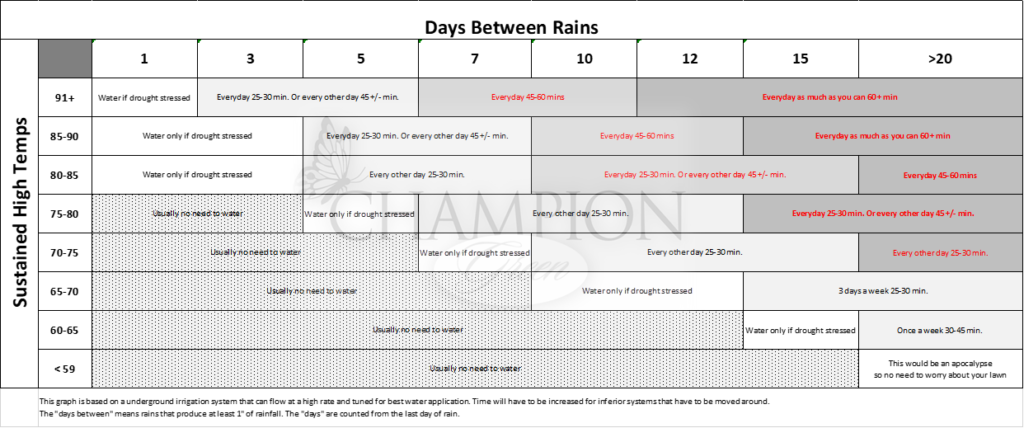
For a complete copy of our Mowing Instructions and official Watering Chart, or for questions regarding specialized add-on treatments, contact the Champion Green office directly:
Phone: (706) 275-8181
Email: info@champion-green.com
Take the first step toward a healthier, greener lawn. Fill out the form with your property details, and our local turf specialists will provide a customized treatment plan tailored to your grass and soil needs.